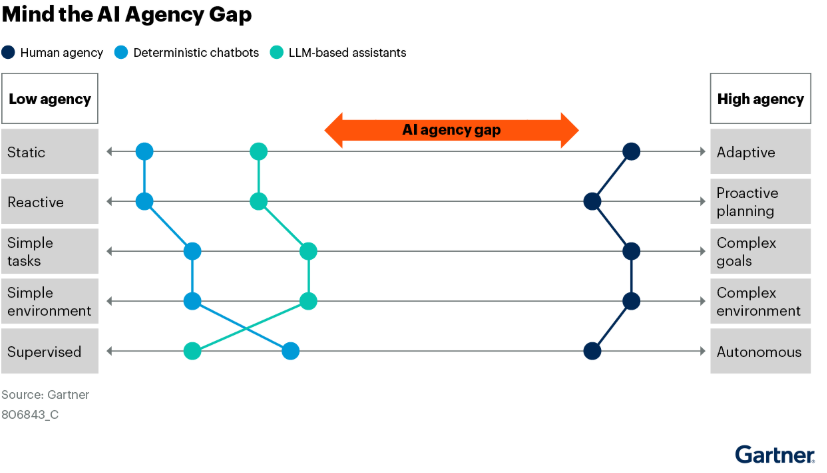
Tools are being built to give systems such as LLMs more agency, the ability to act autonomously with minimal human supervision, adapt to their context and execute goals in complex environments. This will dramatically increase AI’s potential. For example, agentic AI can examine data, perform research, compile tasks to complete and then take those actions in the digital or physical world via APIs or robotic systems.
AI agency is a spectrum. At one end, traditional systems with limited agency perform specific tasks under narrowly defined conditions. At the other end, future agentic AI systems with full agency will learn from their environment, make decisions and perform tasks independently. A large gap exists between current LLM-based assistants and full-fledged AI agents (see Figure 1). This gap will close first for narrowly scoped activities. However, the scope and sophistication of agentic solutions will expand as we learn how to build, govern and trust agentic AI solutions.